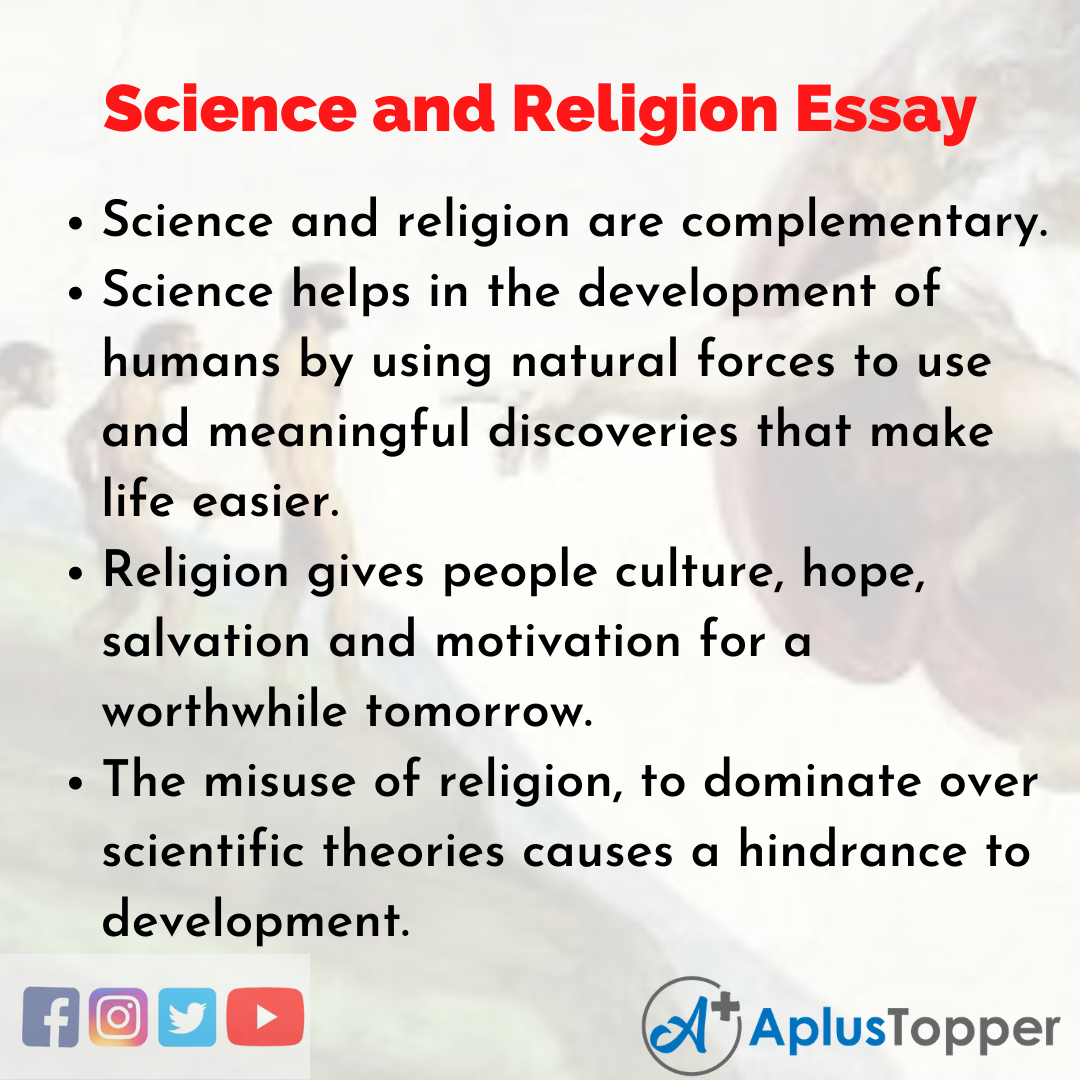
· Science and Religion (SRP ) Science and Religion–two disciplines that at first glance seem to be completely separate modes of thought. After more careful examination one comes to realize that they bump into each other often. Indeed, science and religion seem to have a complex history involving both conflict and resolution. Many theologians, philosophers, and scientists have developed Science Vs Religion Essay. The science versus religion controversy is one in which I believe will continue on until the end of time. Dr. Charlie Townes, a Christian man and renowned scientist, considers the parallels of the two demonstrate they are fated to eventually unite (Townes, ). Many view science and religion as two completely separate realms, which are fundamentally different and ADVERTISEMENTS: Sample essay on the relation between Science and Religion. Science and religion are commonly perceived to be mutually exclusive contradictions in terms, as it were. Both the method and the aims of science and religion seem to be different. Related posts: Interactive essay on the inter-relationship between Science and Religion Science and Religion have [ ]
Science And Religion Essay • English Summary
Over the centuries, the relationship between science and religion has ranged from conflict and hostility to harmony and collaboration, while various thinkers have argued that the two concepts are inherently at odds and entirely separate. But much recent research and discussion on these issues has taken place in a Western context, primarily through a Christian lens. To better understand the ways in which science relates to religion around the world, Pew Research Center engaged a small group of Muslims, Hindus and Buddhists to talk about their perspectives.
These one-on-one, in-depth interviews took place in Malaysia and Singapore — two Southeast Asian nations that have made sizable investments in scientific research and development in recent years and that are home to religiously diverse populations.
The discussions reinforced the conclusion that there is no single, universally held view of the relationship between science and religion, but they also identified some common patterns and themes within each of the three religious groups.
For example, many Muslims expressed the view that Islam and science are basically compatible, while, at the same time, acknowledging some areas of friction — such as the theory of evolution conflicting with religious beliefs about the origins and development of human life on Earth. Evolution also has been a point of discord between religion and science in the West, science and religion essay.
Hindu interviewees generally took a different tack, describing science and religion as overlapping spheres. As was the case with Science and religion essay interviewees, many Hindus maintained that their religion contains elements of science, and that Hinduism long ago identified concepts that were later illuminated by science — mentioning, for example, the antimicrobial properties of copper or the health benefits of turmeric.
In contrast with Muslims, many Hindus said the theory of evolution is encompassed in their religious teachings. Buddhist interviewees generally described religion and science as two separate and unrelated spheres, science and religion essay. Several of the Buddhists talked about their religion as offering guidance on how to live a moral life, while describing science as observable science and religion essay. Often, they could not name any areas of scientific research that concerned them for religious reasons.
Nor did Buddhist interviewees see the theory of evolution as a point of conflict with their religion. For example, Muslim interviewees said cloning would tamper with the power of God, and God should be the only one to create living things. When Hindus and Buddhists discussed gene editing and cloning, science and religion essay, some, though not all, voiced concern that these scientific developments might interfere with karma or reincarnation.
But religion was not always the foremost topic that came to mind when people thought science and religion essay science. In response to questions about government investment in scientific research, interviewees generally spoke of the role of scientific achievements in national prestige and economic development; religious differences faded into the background.
These are some of the key findings from a qualitative analysis of 72 individual interviews with Muslims, Hindus and Buddhists conducted in Malaysia and Singapore between June 17 and Aug, science and religion essay. The study included 24 people in each of three religious groups Muslims, Hindus science and religion essay Buddhistswith an equal number in each country.
A majority of Malaysians are Muslim, and the country has experienced natural migration patterns over the years. As a result, Buddhist interviewees in Malaysia were typically of Chinese descent, Hindus were of Indian descent and Muslim interviewees were Malay. Singapore is known for its religious diversity; a Pew Research Center analysis found the city-state to have the highest level of religious diversity in the world.
Insights from these qualitative interviews are inherently limited in that they are based on small convenience samples of individuals and are not representative of religious groups either in their country or globally. Where possible throughout the rest of this report, these findings are shown in comparison with quantitative surveys conducted with representative samples of adults in global publics to help science and religion essay questions about the extent to which certain viewpoints are widely held among members of each religious group.
This also shows how Muslims, Hindus and Buddhists as well as Christians around the world compare with each other. The goal of this project was to better understand how people think about science in connection with their religious beliefs. Past research on this topic has often focused on the views of Christians living in the U. or other economically advanced nations. This study sought to fill that gap by talking, one-on-one, with Muslims, Hindus and Buddhists living in two growing economies in Southeast Asia: Malaysia and Singapore.
Pew Research Center conducted science and religion essay interviews with 72 people, including 24 in each of the three religious groups 12 in each country. They varied in other demographic characteristics, including age, gender, ethnicity, profession, employment status and educational attainment, science and religion essay.
Interviews were conducted by Ipsos Qualitative with a local, professional interviewer, using a guide developed by Pew Research Center. Interviews lasted about one hour and were conducted in English in Singapore, and in English or Malay in Malaysia.
The Singaporean interviews were conducted June 17 to July 26,and the Malaysian interviews were done July 31 to Aug. Center researchers listened to audio recordings of the interviews and systematically coded transcripts for thematic responses, using qualitative data analysis software, science and religion essay. Themes were revised science and religion essay integrated throughout the coding process, until researchers agreed upon a consistent set of categories.
The qualitative interviews are based on small, convenience samples of individuals and are not representative of religious groups in either country.
Whenever possible, these findings are shown in comparison with quantitative data from global surveys using representative samples of adults who identify as Muslim, Hindu, Buddhist or Christian. You can find the interview guide here. Interviewees paint three distinct portraits of the science-religion relationship One of the most striking takeaways from interviews conducted with Muslims, Hindus and Buddhists stems from the different ways that people in each group described their perspectives on the relationship between science and religion.
The Muslims interviewed tended to speak of an overlap between their religion and science, and some raised areas of tension between the two. Hindu interviewees, science and religion essay, by and large, described science and religion as overlapping but compatible spheres. By contrast, Buddhist interviewees described science and religion as parallel concepts, with no particular touchpoints between the two.
A similar pattern emerged when interviewees were asked about possible topics that should be science and religion essay limits to scientific research for religious reasons. Many Muslim interviewees readily named research areas that concerned them, such as studies using non-halal substances or some applications of assisted reproductive technology for example, in vitro fertilization using genetic material from someone other than a married couple.
By contrast, the Hindus and Buddhists in the study did not regularly name any research topics that they felt science and religion essay be off limits to scientists. From what I know in the Quran, they say that there is science in Islam. They talk about the sun, the moon, the stars.
They talk about how the water can go up to the sky and become the clouds. Yeah, I believe what the Quran says, [rather] than scientific proof. Muslims frequently described science and their religion as related, rather than separate, concepts. They often said that their holy text, science and religion essay, the Quran, contains many elements of science. The Muslims interviewed also said that Islam and science are often trying to describe similar things.
The Muslims interviewed offered a wide variety of opinions about the nature of the relationship between science and religion, and whether the two are harmonious or conflicting, science and religion essay. Some described science and Islam as compatible overall, science and religion essay. Others qualified their statement by saying that science is compatible with religion, science and religion essay, but the actions of individual scientists can be problematic.
I think there is not any conflict between them. Still others described the relationship as conflictual. Another interviewee said scientists typically do not consider the views of religious people when conducting their research.
When asked, many of the Muslims interviewed identified specific areas of scientific research that bothered them on religious grounds. Representative surveys of Muslims in countries around the world find variation in the share of Muslims who see any conflict between science and religion, science and religion essay, although this share is less than half in most countries surveyed, science and religion essay.
The predominant view among Hindus interviewed in Malaysia and Singapore is that science and Hinduism are related and compatible. Many of the Hindu interviewees offered — without prompting— the assertion that their religion contains many ancient insights that have been upheld by modern science. For instance, multiple interviewees described the use of turmeric in cleansing solutions, or the use of copper in drinking mugs.
For example, it is said that drinking water from a copper container is very good. Science and religion essay has been proven by the ancestors many years ago. But now only these scientific people come out and say that it is good to use it. Why would you need to restrict yourself from information or knowledge? Because Hinduism is based on knowledge. While many of the Hindu interviewees said science and religion overlap, others described the two as separate realms.
Science should just be science. A few mentioned areas of research that concerned them, but no topic area came up consistently. The sense that Hindus generally see little conflict with science aligns with survey findings to date.
Buddhist interviewees described science and religion in distinctly different ways than either Muslims or Hindus. For the most part, Buddhists said that science and religion are two unrelated domains.
Some have long held that Buddhism and its practice are aligned with the empirically driven observations in the scientific method ; connections between Buddhism and science have been bolstered by neuroscience research into the effects of Buddhist meditation at the core of the mindfulness movement.
And science is more practical, but Buddhism is theoretical. It is not conflicting. Religion is more of something you cannot see, you cannot touch, you cannot hear. I feel like they are different faculties. To many of the Buddhist interviewees, science and religion cannot be in conflict, because they are different or parallel realms. Therefore, the Malaysian and Singaporean Buddhists largely described the relationship between science and religion as one of compatibility.
Science to me is statistics, numbers, texts — something you can see, you can touch, you can hear. Indeed, even when prompted to science and religion essay about potential areas of scientific research that raised concerns for religious reasons, relatively few of the Buddhists mentioned any. Among those who did cite a concern, a common response involved animal testing. Buddhist interviewees talked about the science and religion essay of not killing living things in the practice of their religion, so some felt that research that causes harm or death to animals is worrisome.
The tenor of these comments is consistent with survey findings from the Wellcome Global Monitor. Science and religion essay, these results should be interpreted with extra caution because there were just Malaysian Buddhists in the survey sample.
For comparison, representative surveys of Christians around the world also find widely ranging views about whether religion and science have ever disagreed or are generally in conflict. Pew Research Center surveys asked a similar question in Central and Eastern Europe as well as in Latin America. Such findings broadly align with Elaine Howard Ecklund and Christopher P. Christians see little conflict between science and their faith.
This survey also provides a window into the kinds of things that Christians see as a conflict between science and religion. Christians who saw a conflict between science and their religious beliefs, science and religion essay. Evolution raised areas of disagreement for many Muslim interviewees, who often said the theory of evolution is incompatible with the Islamic tenet that humans were created by Allah.
Evolution is also a common, though by no means universal, friction point for Christians. By contrast, neither Buddhist interviewees, followers of a religion with no creator figure, nor Hindu interviewees, followers of a polytheistic faith, described discord with evolution either in their personal beliefs or in their views of how evolution comports with their religion.
Science and religion essay asked about the theory of evolution, Muslim interviewees generally talked about conflict between the theory of evolution and their religious beliefs about the origins of human life — specifically, the belief that God created humans in their present form, science and religion essay, and that all humans are descended from Adam and Eve.
(Review Essay) Science \u0026 Religion in PROMETHEUS
, time: 13:58Essay on Religion and Science ( Words)
· Long Essay on Science and Religion Words in English. Long Essay on Science and Religion is usually given to classes 7, 8, 9, and Since the 19th century, the relationship between science and religion has been characterized by ‘harmony,’ ‘conflict,’ ‘complexity,’ and · Essay Homework Help offers academic writing services to students either struggling to write their own papers or who lack sufficient time to complete their paper on time. Whether you are looking for extra hours to be with your family, ill or you are running out of time, simply contact our MBA Writers via the order button below and we will be glad to assist Essay On Science And Religion. Subject: Other Topic: Essay. Introduction: This is the age of science. But religion is a belief in higher unseen controlling power. They have a reciprocal relation. “Science” and “Religion” are not eternally unchanging terms with unambiguous meanings. Indeed, they are terms that were coined recently, with meanings that vary across times and cultures


No comments:
Post a Comment